Okay, I’m the first to admit that it’s been awhile since I blogged last. But I’ve been distracted. I’ve been playing Uno. Now Uno, as just about every American child knows, is a card game involving four colors and a few mixed wild and specialty cards distributed by Mattel. The instruction manual comes in five languages so I’m assuming that it is an international phenomenon and not just an American one. The game is played by 2-10 players at a time, going around in a circle with players discarding a blue, green, red, or yellow card matching the color or number of the previously-discarded card. The player to discard all their cards first is the winner. The concept is complicated by the inclusion of Skip, Reverse, Pick 2, Pick 4, and wild cards which will, in various ways, doom your neighbor to your advantage.
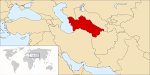
Something about this simple game touches the Turkmen psyche and it has caught on in ways I never imagined. I have seen children get off their chair, kneel on the floor, and beg their classmate to declare a wild card a yellow rather than green. My host brother bangs on my door at eleven at night begging to show the cards off to his friends. My 28-year old widowed host-sister mentions the time I made her Pick 4 three times in a row while we make dinner. My students complete grammar worksheets in record time with the promise of a half-hour of Uno hanging above their heads. Knowing I’ll be more likely to play if in a good mood, my host mother cooks me non-sheep-fat variations of the main meal.
My single deck of Uno cards, found abandoned in the Peace Corps office Free Box, is probably the single most valuable and coveted object within 50 miles. So, if you want to know what I’ve been up to for the past two months, it’s a simple answer.
Playing cards.
In other news – I received a 1 million pound full-tuition scholarship to attend Webster’s University in London, a part of Regent’s College, starting January 8, 2010. I’m going to check it out on my London plane layover in July and if the place isn’t a swindle, then I’m UK-bound three weeks after I come home from Turkmenistan. This time you all can come visit me.
Wednesday, June 10, 2009

Friday, April 24, 2009
Friday, April 3, 2009
the future
April already, huh. It’s true what they say: each week may seem like an eternity, but the moment you look at a calendar you realize that the second year of Peace Corps really does fly by. I’ve been in Turkmenistan for a year and a half and I can still remember the first three months of training more clearly than the nightmare I had last night. I know my post-Peace Corps plans are of great interest to the world (and if they’re not, then you haven’t been paying attention), so I figure I’ll give a brief run-down. I am applying to two grad schools: Webster’s Graduate School (part of Regents College in downtown London), and The New School: Milano (downtown Manhattan). No more village life for me. Regardless of which school accepts me, I plan on getting my masters in Non-Profit Management with an international focus in women’s rights. Both have programs starting January, 2010; Webster’s finishing in one year while The New School finishes in two. If, however, I don’t get accepted for the January semester in either New York or London I will:
1) Join my cousin Jon on one of his organic farm cooperatives (hopefully some place foreign)
2) Get a job as a recruiter for Peace Corps at DC headquarters
3) Be an English teacher in Korea for a year (where you can easily save $1000 a month, according to some RPCV pals currently living there, even while living like a rock star)
4) Rejoin Peace Corps and hope they assign me a job as something other than an English teacher or youth coordinator
5) Take macro and micro economics (and creative writing) courses at Prince George’s Community College or Montgomery Community College as preparation for a more impressive application to Yale Graduate School for non-profit management
Here is what I will NOT do (remind me of this when these all become viable options):
1) Work at Ann Taylor or some other mall retail outlet
2) Sit around my parents’ house as a moody lump doing nothing to propel myself forward in my life except watch movies and write crap vampire novels
3) Be a high school substitute teacher
4) Get a job somewhere that includes cubicles, felt walls, and smiley face pins – unless I’m there undercover as a spy and have a license to kill
As a reminder, I am still accepting boxes of children’s illustrated books and fashion magazines to build my blooming English language library. Thank you so much to everyone who has already sent me something, even two or three magazines from CVS can really be an eye-opener and source of joy to a Turkmen child. Address available upon request.
1) Join my cousin Jon on one of his organic farm cooperatives (hopefully some place foreign)
2) Get a job as a recruiter for Peace Corps at DC headquarters
3) Be an English teacher in Korea for a year (where you can easily save $1000 a month, according to some RPCV pals currently living there, even while living like a rock star)
4) Rejoin Peace Corps and hope they assign me a job as something other than an English teacher or youth coordinator
5) Take macro and micro economics (and creative writing) courses at Prince George’s Community College or Montgomery Community College as preparation for a more impressive application to Yale Graduate School for non-profit management
Here is what I will NOT do (remind me of this when these all become viable options):
1) Work at Ann Taylor or some other mall retail outlet
2) Sit around my parents’ house as a moody lump doing nothing to propel myself forward in my life except watch movies and write crap vampire novels
3) Be a high school substitute teacher
4) Get a job somewhere that includes cubicles, felt walls, and smiley face pins – unless I’m there undercover as a spy and have a license to kill
As a reminder, I am still accepting boxes of children’s illustrated books and fashion magazines to build my blooming English language library. Thank you so much to everyone who has already sent me something, even two or three magazines from CVS can really be an eye-opener and source of joy to a Turkmen child. Address available upon request.
Friday, March 13, 2009
Hard core, Peace Corps
English textbooks really don’t have Turkmenistan in mind when writing example dialogues and exercises. Don’t get me started on an entire text about how to ski. Take, for instance, this dialogue practicing adverbs of frequency, the present simple vs. present continuous tense, and expressing incongruity.
A: What are you doing?
B: I’m washing the dishes in the bathtub.
A: That’s strange! Do you usually wash dishes in the bathtub?
B: No, I never wash dishes in the bathtub, but I’m washing dishes in the bathtub today.
A: Why are you doing that?
B: Because my sink is broken.
A: I’m sorry to hear that.
Students are then supposed to substitute the action and broken object with new words, such as sleeping on the floor because the bed is broken, walking to work because the car isn’t working, using a typewriter because the computer is broken, and sweeping the carpet because the vacuum is busted. But here’s the problem: not only do most of my students no have sinks – or running water in their house – they probably haven’t seen a bathtub outside of TV. They wash with basins of water headed over a gas furnace and water stored in an underground tank. They also sleep on the floor on 1-inch thick hard mats on a nightly basis because they say beds make their back hurt (I pile my mats 3 high). Unless you’re a taxi driver, no one drives to work and I can count the number of household computers in the whole town on one hand. I’ve seen a few vacuums around, mostly used as novelties to show off to guests, but daily sweeping all the carpets in the house is a Turkmen compulsion as necessary for well-being as eating and sleeping.
So we PCV have written a “For Turkmen” companion to our English textbooks. In this version, the unusual action is driving, not walking, and they’re driving because it’s raining (getting wet invites such hazards as fevers, flu, and frozen wombs). Other examples include shouting at the neighbors because the telephone isn’t working; cooking over a fire because the gas was cut off; studying English by candlelight because the electricity isn’t working; and sleeping outside because the fan is busted and it’s too hot inside. These are the “strange,” – and yet not al that rare – occurrences that are just part of daily life here.
Did you hear? It’s official, Turkmenistan PCV live the most hard-core lives on the planet in the most isolated place on earth. Antarctica, the former reigning champ of all things isolated and challenging, now has high speed Internet access and regular meals made from fresh gourmet food imported daily.
According to Discovery Channel News, the new Belgian “Princess Elizabeth” scientific research center opened February 17, 2009 looking like a “flying saucer on stilts” and powered by a state-of-the art, wind and sun-powered, zero emissions system. Unlike Antarctica researchers of old who talked to the outside world via Morse Code and 8-day long boat rides, current residents have access to the outside world in ways we T-stan PCV can only fantasize: Internet in their very own rooms.
Antarctica was largely neglected after its discovery in the 1890s because of its “hostile environment, lack of resources, and isolation,” attributes which in Turkmenistan have been considered bragging points and reasons to stick it out as volunteers. Of course, the only natural inhabitants of Antarctica are cold-adapted plants and animals such as penguins, seals, mosses, and lichen. The natural inhabitants of Turkmenistan are heat-adapted creatures surviving on the fuel of gossip and sheer daiza-driven will (the evergreen trees are exceptions and refuse to survive despite the late President’s wishes, the insufferable wretches). I suppose it’s a matter of debate about which is a more hard core smell to have lingering in your hair at the end of the day: boiled sheep liver or penguin poop.
A: What are you doing?
B: I’m washing the dishes in the bathtub.
A: That’s strange! Do you usually wash dishes in the bathtub?
B: No, I never wash dishes in the bathtub, but I’m washing dishes in the bathtub today.
A: Why are you doing that?
B: Because my sink is broken.
A: I’m sorry to hear that.
Students are then supposed to substitute the action and broken object with new words, such as sleeping on the floor because the bed is broken, walking to work because the car isn’t working, using a typewriter because the computer is broken, and sweeping the carpet because the vacuum is busted. But here’s the problem: not only do most of my students no have sinks – or running water in their house – they probably haven’t seen a bathtub outside of TV. They wash with basins of water headed over a gas furnace and water stored in an underground tank. They also sleep on the floor on 1-inch thick hard mats on a nightly basis because they say beds make their back hurt (I pile my mats 3 high). Unless you’re a taxi driver, no one drives to work and I can count the number of household computers in the whole town on one hand. I’ve seen a few vacuums around, mostly used as novelties to show off to guests, but daily sweeping all the carpets in the house is a Turkmen compulsion as necessary for well-being as eating and sleeping.
So we PCV have written a “For Turkmen” companion to our English textbooks. In this version, the unusual action is driving, not walking, and they’re driving because it’s raining (getting wet invites such hazards as fevers, flu, and frozen wombs). Other examples include shouting at the neighbors because the telephone isn’t working; cooking over a fire because the gas was cut off; studying English by candlelight because the electricity isn’t working; and sleeping outside because the fan is busted and it’s too hot inside. These are the “strange,” – and yet not al that rare – occurrences that are just part of daily life here.
Did you hear? It’s official, Turkmenistan PCV live the most hard-core lives on the planet in the most isolated place on earth. Antarctica, the former reigning champ of all things isolated and challenging, now has high speed Internet access and regular meals made from fresh gourmet food imported daily.
According to Discovery Channel News, the new Belgian “Princess Elizabeth” scientific research center opened February 17, 2009 looking like a “flying saucer on stilts” and powered by a state-of-the art, wind and sun-powered, zero emissions system. Unlike Antarctica researchers of old who talked to the outside world via Morse Code and 8-day long boat rides, current residents have access to the outside world in ways we T-stan PCV can only fantasize: Internet in their very own rooms.
Antarctica was largely neglected after its discovery in the 1890s because of its “hostile environment, lack of resources, and isolation,” attributes which in Turkmenistan have been considered bragging points and reasons to stick it out as volunteers. Of course, the only natural inhabitants of Antarctica are cold-adapted plants and animals such as penguins, seals, mosses, and lichen. The natural inhabitants of Turkmenistan are heat-adapted creatures surviving on the fuel of gossip and sheer daiza-driven will (the evergreen trees are exceptions and refuse to survive despite the late President’s wishes, the insufferable wretches). I suppose it’s a matter of debate about which is a more hard core smell to have lingering in your hair at the end of the day: boiled sheep liver or penguin poop.
Sunday, March 1, 2009
books, magazines, journals, oh my!
I’ve set up a small (very small) library in my classroom. It’s one shelf long of mostly picture books and a few illustrated classics like Huck Finn and Alice in Wonderland. The Darien Book Aid people finally came through, and I got around to setting it up. Kids are already showing curiosity and I’m trying to figure out how best to use it in class – winner of a game gets a book for the weekend? Take out a book and come back next class with 10 new words? It could work. So far my sophisticated library system is to have the kids swarm the shelf at the end of class, find something they like, I sign it out, they bring it back in a week. I’m not giving reading assignments yet, I’m not making them *do* anything at all, but I want them to think of books as a privilege and a wonder, not a chore. I just want the kids to *want* to read, something definitely lacking so far in their educational experience. If the only books I’d ever seen or read in my life were textbooks, I would also want to read like a cat wants to be thrown against the wall. But, so far, they seem to like them. We’ll see how long it takes for the novelty to wear off, but I’m excited that they have books in their hands and they leave class excited and exchanging looks at each others’ covers. Brings me a little glimmer of what I can only describe as joy: I did that. I brought those kids something they’d never experienced before: excitement about books. Am I awesome or what? Sometimes I really like my job.
So far my library has exactly 27 items, that’s including each National Geographic and People magazine counted individually. There’s not enough for every kid to take out a book at the same time, but I’m working on that. Unfortunately, the recession being what it is, Darien Book Aid can’t send a second shipment, so I’m improvising.
And YOU can help!!
If you want to be part of building a library in the developing world, send me kids’ picture books and fashion magazines. Illustrations and photos are key. If you’re worried about the weight, our dear US Postal Service offers the “flat rate” box, where shipping costs the same regardless of whether the box is filled with feathers, bricks, or, yes, books for learning Turkmen boys and girls. The address of where to send them is available upon request, just remember that my remaining time here is ticking away so mail your contribution today. And I sound like PBS, when did that happen?
So far my library has exactly 27 items, that’s including each National Geographic and People magazine counted individually. There’s not enough for every kid to take out a book at the same time, but I’m working on that. Unfortunately, the recession being what it is, Darien Book Aid can’t send a second shipment, so I’m improvising.
And YOU can help!!
If you want to be part of building a library in the developing world, send me kids’ picture books and fashion magazines. Illustrations and photos are key. If you’re worried about the weight, our dear US Postal Service offers the “flat rate” box, where shipping costs the same regardless of whether the box is filled with feathers, bricks, or, yes, books for learning Turkmen boys and girls. The address of where to send them is available upon request, just remember that my remaining time here is ticking away so mail your contribution today. And I sound like PBS, when did that happen?
Sunday, February 15, 2009
Pain in the ...
Why is it that some days feel absolutely epic and others fly? Last week flew, this week trudges. This morning’s classes felt like 5 hours rather than 3. I then helped prepare lunch for another 2 hours (even with three people Turkmen meals take awhile to prep), napped the nap of the exhausted, and then returned to school for another 4 hours. On a slow day, every lesson feels like it has the high gravity mass to warp time around itself and make it move slower than its normal path. I finally got around again to the class where I dislocated my shoulder and they look at me with a kind of frightened awe, as it I might spontaneously combust at any moment. It takes the pressure off making an interesting lesson plan when my sling is such an object of morbid fascination. I’ve started wearing my sling only when I teach (when I’m most tempted to fling that arm about) and then leaving it off while I walk around and sit with the family, as I draw enough attention without looking like an amputee under my coat.
Friday, February 6, 2009
use small gestures
"And the house was *this* big!"
And that's the part where I fling my arms out so wide I throw my right arm out of the socket, cry out like a wounded wildebeest, sink to the floor in front of 20 terrified Turkmen children, pop it back in with a sickly squishing sound, and cancel class. I've never see them move so fast out the door. Then came in the flurry of teachers, a mix of genuinely concerned, genuinely curious, and genuinely gossip-hungry. We called PC for advice, preferably for instructions on how long to hold on the heat pad/ice pack, and got strict instructions to come to the office RIGHT NOW! So, still dressed in my bright floral Turkmen koinek school uniform, I packed up my stuff one-handed (my usually useless left arm appendage got more work than it has in the last year), and came to the city. As soon as I arrived at the office I was hurried to the hospital for a series of tests and prods that seemed more appropriate for a fracture rather than a dislocated shoulder (especially a dislocated shoulder that's back in it's proper joint already): shots, X-rays, and emergency room tendon specialist called in from home. All for poor little old me. The result is that I have to wear a really annoying sling for two weeks, I'm not allowed to raise my arm about my head, and after two weeks I'm going to have to do intensive exercises to build up the muscle so that it will properly hold my bone in the socket. Apparently I have a naturally really flexible bone structure, but that comes at the price of joints more prone to disconnect. Well, I may have to wear a sling, but it's worth the story of reattaching my own arm in class.
And that's the part where I fling my arms out so wide I throw my right arm out of the socket, cry out like a wounded wildebeest, sink to the floor in front of 20 terrified Turkmen children, pop it back in with a sickly squishing sound, and cancel class. I've never see them move so fast out the door. Then came in the flurry of teachers, a mix of genuinely concerned, genuinely curious, and genuinely gossip-hungry. We called PC for advice, preferably for instructions on how long to hold on the heat pad/ice pack, and got strict instructions to come to the office RIGHT NOW! So, still dressed in my bright floral Turkmen koinek school uniform, I packed up my stuff one-handed (my usually useless left arm appendage got more work than it has in the last year), and came to the city. As soon as I arrived at the office I was hurried to the hospital for a series of tests and prods that seemed more appropriate for a fracture rather than a dislocated shoulder (especially a dislocated shoulder that's back in it's proper joint already): shots, X-rays, and emergency room tendon specialist called in from home. All for poor little old me. The result is that I have to wear a really annoying sling for two weeks, I'm not allowed to raise my arm about my head, and after two weeks I'm going to have to do intensive exercises to build up the muscle so that it will properly hold my bone in the socket. Apparently I have a naturally really flexible bone structure, but that comes at the price of joints more prone to disconnect. Well, I may have to wear a sling, but it's worth the story of reattaching my own arm in class.
Subscribe to:
Posts (Atom)